
The Illusion of Understanding

How Language Can Conceal Critical Information in Investigative Interviews

Why effective interviewers must explore the meaning behind words rather than assume they understand them.
The Investigative Interview Institute® (I³)

Consider This
Imagine conducting an investigative interview involving a consequential decision that resulted in serious injury, loss of life, or another significant outcome.
During the interview, a witness offers the following statement:
“Based upon my expectations, I felt it was reasonable that John behaved in that manner given the circumstances. He was in a no-win situation. I felt badly for him given the outcome.”
At first glance, the statement seems understandable. The witness apparently believes John’s behavior was reasonable, recognizes the difficult circumstances he faced, and expresses sympathy for the outcome.
But consider what the statement actually tells us. What were the witness’s expectations? What behavior was considered reasonable? What circumstances influenced that judgment? What made the situation a no-win situation? And what outcome produced the witness’s emotional response?
Perhaps more importantly, which portions of the statement describe something the witness actually experienced, and which represent interpretations or judgments formed afterward?
How much could the witness actually know about John’s circumstances, available choices, or reasoning?
Before reading further, consider how you might respond. Would you accept the explanation as reasonably clear? Would you ask for additional information? How would you determine which parts required clarification?
Two Interviewers, One Statement
Consider two interviewers who receive the same statement.
Interviewer A: “So you believe John made the right decision and didn’t have any other options?”
Interviewer B: “You mentioned that you believed John’s behavior was reasonable. Can you help me understand what you mean by reasonable?”
Both appear to seek clarification, yet their approaches are fundamentally different. Interviewer A introduces two propositions the witness did not expressly communicate: John made the right decision and had no other options. Interviewer B invites the witness to explain the intended meaning of their own words.
An interviewer may believe they understand a statement while unknowingly assigning meaning that the interviewee never intended to communicate.
Language Is an Imperfect Means of Communicating Human Experience
“Language is an imperfect means of communicating human experience. What is said, what is meant, and what is understood are not necessarily the same.”
— The Investigative Interview Institute® (I³)
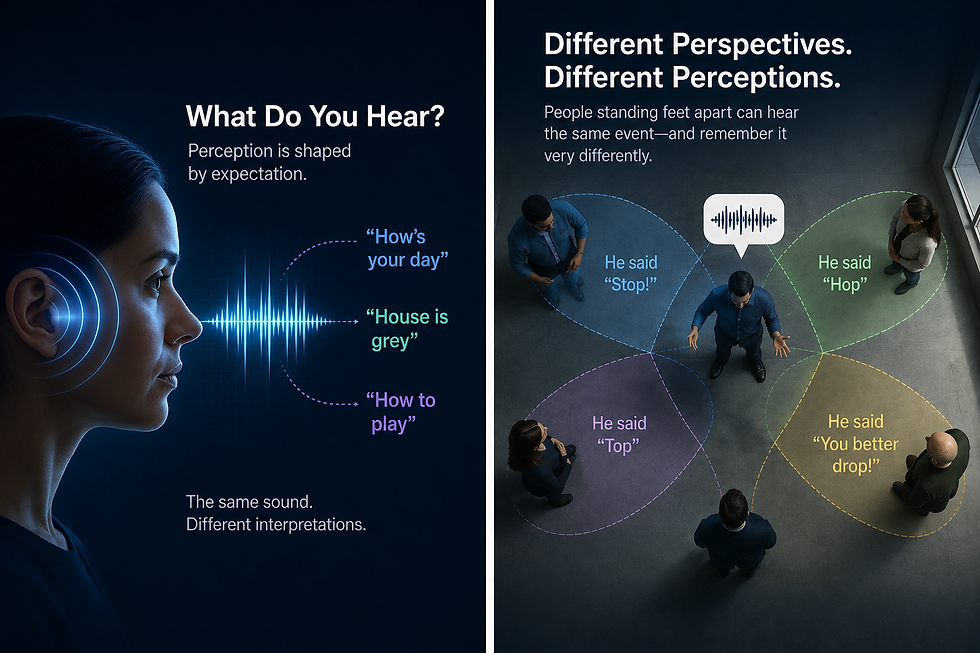
Human beings use language to communicate experiences, perceptions, memories, emotions, and reasoning. Yet language does not provide a complete representation of those experiences. Individuals select words to summarize complex mental processes, frequently assuming that others understand the surrounding context. Listeners interpret spoken language through their own knowledge, expectations, and experiences.
Communication involves more than exchanging words; it requires developing an understanding of what those words are intended to convey. Grice (1975) examined how conversational meaning extends beyond literal content, helping distinguish what people explicitly say from what listeners infer. Clark and Brennan (1991) examined how successful communication depends on establishing and maintaining common ground—the information and understandings participants treat as shared.
Two individuals may use the same words while assigning different meanings to them. In high-stakes investigations, such differences can influence how observations, decisions, and reasoning are documented and interpreted. The challenge is recognizing when familiar language creates the appearance of understanding without actually establishing it.
Three Challenges to Understanding
Linguistic Ambiguity
An expression permits multiple reasonable interpretations. “He was right” might mean correct, justified, or positioned on the right side. The intended meaning cannot necessarily be established from the expression alone.
Underspecification
A statement communicates a general idea without enough detail to establish its specific meaning. “He behaved in that manner” references behavior without describing it. The problem is missing detail, not necessarily competing meanings.
Inference
The interviewer supplies an interpretation beyond what the speaker explicitly communicated. Witness: “He had no other choice.” Interviewer: “So you’re saying he was forced to act?” The interviewer has introduced a possible interpretation, although the witness might instead mean limited alternatives, perceived pressure, or a difficult decision.
Ambiguity concerns possible meanings; underspecification concerns missing detail; inference concerns meaning supplied by a listener. The objective is to understand the interviewee’s account without replacing it with the interviewer’s interpretation.
Unpacking the Statement

Return to the original example. Several expressions merit clarification, but an effective interviewer should not interrupt the initial narrative to dissect each one. The interviewer can listen attentively, make brief notes, let the account develop, and revisit material uncertainties through witness-compatible, open-ended invitations. This is consistent with Cognitive Interview principles discussed by Fisher and Geiselman (1992, 2010).
“Based upon my expectations...”
What did the witness anticipate? Were expectations based on prior experience, information available at the time, or knowledge acquired afterward?
Possible invitation: “You mentioned your expectations. Can you help me understand your expectations of the situation or its outcome?”
Allow the witness to explain how those expectations relate to the experience, without supplying possible explanations.
“I felt it was reasonable...”
Reasonable is an evaluation, not a description of particular observable behavior. Different people may apply different standards.
Possible invitation: “You described his behavior as reasonable. Can you help me understand what you mean by reasonable?”
Further open-ended clarification can identify the observations or experiences underlying that assessment without prematurely challenging it.
“...that John behaved in that manner...”
The witness characterizes behavior without describing it. What was actually seen or heard, and in what sequence?
Possible invitation: “You mentioned the manner in which John behaved. Please tell me more about what you remember John doing.”
“He acted aggressively” expresses an interpretation; “He raised his voice and stepped toward me” reports particular actions. Both can be relevant but are not interchangeable.
“...given the circumstances.”
Which circumstances were actually perceived? Were others learned afterward?
Possible invitation: “You mentioned the circumstances. Please tell me more about the circumstances you are referring to.”
Avoid supplying examples that might shape the response.
“He was in a no-win situation.”
What did no-win mean to the witness? What alternatives did the witness perceive? Was this an understanding held during the event or reached afterward? Critically, what could the witness actually know about John’s understanding?
Possible invitation: “You described the situation as no-win. Can you help me understand what you mean by that?”
A belief that another person faced an impossible decision does not independently establish what that person perceived, knew, considered, or intended. An interviewer should avoid turning one person’s interpretation of another person’s mental state into an established fact.
“I felt badly for him given the outcome.”
What outcome, and what emotional response? When did it arise? What had the witness believed would happen?
Possible invitation: “You mentioned feeling badly for John because of the outcome. Can you tell me more about that?”
The response may help distinguish an original understanding from an interpretation developed after learning the outcome.
The Importance of Temporal Separation
Experiences unfold over time, but people may describe past observations and present interpretations together. A witness may explain an event using information acquired later without explicitly distinguishing that knowledge from what was available at the time.
When the witness says John was in a no-win situation, was this understood beforehand, perceived as events unfolded, concluded after learning the outcome, or developed while reflecting during the interview? These possibilities are not equivalent.
Temporal dimension | Information requiring clarification |
Before the event | What did the witness expect, anticipate, or believe would happen? |
During the event | What did the witness perceive, experience, and understand at that time? |
After the event | What additional information became available, and what interpretations developed? |
At the interview | How does the witness currently remember, understand, and explain the experience? |
These distinctions do not prove an interpretation incorrect, nor can a person necessarily identify when every belief originated. Temporal clarification can reveal potential differences between contemporaneous understanding and retrospective interpretation.
The Science of Source Monitoring
Johnson, Hashtroudi, and Lindsay (1993) describe cognitive processes by which people attribute remembered information to perception, conversations, imagination, or reflection. Such source judgments are not infallible. A person may remember information while remaining uncertain whether it arose from direct experience, later discussion, external materials, or internally generated inference.
This framework does not mean that questioning can reliably recover every original source. Rather, it explains why information origins matter and why source uncertainty should be preserved.
What someone understood during an event and what they understand afterward are not necessarily the same.
What the Witness Knows—and What the Witness Believes
Consider statements such as “He knew what was going to happen,” “She had no reason to be afraid,” “He realized there was no other choice,” or “She intentionally ignored the warning.” Each appears to convey another person’s mental state. Yet the account might derive from something the person actually said, observed behavior, prior familiarity, or subsequent inference.
These statements should neither be accepted as direct knowledge nor dismissed automatically. They may convey important observations and interpretations, but their basis must be understood.
A witness’s belief about another person’s mental state is information about the witness’s belief. It does not, by itself, establish the other person’s actual mental state.
Word Choice Is Critical: Are You Clarifying or Influencing?

Your words matter. During an investigative interview, the language you introduce may do more than clarify an individual's account. It may influence how questions are interpreted, how information is reported, and potentially how an experience is subsequently remembered.
Loftus and Palmer (1974) found that wording influenced participants’ speed estimates after viewing vehicle collisions. Questions using “smashed” produced higher average estimates than less forceful verbs; in a later experiment, wording also affected reports of broken glass that was not present.
This does not demonstrate that every suggestive question alters memory or directly validate the sample invitations in this article. It does establish a scientific reason to consider carefully what language interviewers introduce. Returning to the opening example, Interviewer A supplies conclusions about correctness and alternatives, whereas Interviewer B invites the witness to explain their own meaning.
The distinction is between inviting the interviewee to explain an account and inviting the interviewee to adopt the interviewer’s explanation.
Clarification Without Disrupting Retrieval
Recognizing uncertain language does not demand immediate clarification of every expression. Interruptions can disrupt a developing account. Cognitive Interview research emphasizes memory retrieval, communication, social interaction, and appropriate questioning (Fisher & Geiselman, 1992, 2010; Fisher, Milne, & Bull, 2011).
The interviewer can briefly note “expectations — reasonable — manner — circumstances — no-win — outcome” as reminders rather than conclusions. After the initial account, the interviewer can return to material topics using the interviewee’s words, beginning with broad invitations and narrowing only when appropriate.
The questions in this article illustrate applications of research-based interviewing principles; they are not a separately validated questioning protocol.
Understanding Does Not Establish Accuracy
A detailed explanation does not establish that it accurately represents original perceptions, reasoning, or memory.
A witness might thoroughly explain a belief that John had no alternatives, but that explanation does not establish what options John actually perceived or whether the witness’s present explanation accurately reconstructs their earlier thinking.
Koriat and Goldsmith (1996) studied people’s regulation of memory reporting, including decisions to supply or withhold uncertain information. Their findings provide a reason to preserve meaningful uncertainty, not evidence that the specific prompts used here have been tested. “I don’t know,” “I don’t remember,” and “I’m not sure” may be the most informative answers available.
The Interviewer’s Expectations Matter Too
Interviewers bring their own knowledge, assumptions, and experiences. They may interpret “reasonable” according to their own standards, assume that “circumstances” are already understood, or construct an explanation for “no-win” from other case information. Such inferences need not be deliberate.
Are we documenting what the interviewee remembers and means, or what we believe the interviewee must have meant?
One Principle, Multiple Professions
Aviation safety investigations
“I thought we were committed to the approach.”
What did committed mean? What information supported that understanding, and when was it held?
Healthcare incident reviews
“The patient appeared stable.”
What observations supported stable, and what information was available at the time?
Workplace investigations
“I felt I had no choice.”
What alternatives did the individual perceive, and when was that understanding formed?
Criminal investigations
“He was acting aggressively.”
What actions were observed, and what did aggressively mean to this witness?
Across professions, interviewers must distinguish observations, experiences, beliefs, and interpretations without prematurely imposing an external explanation. Investigative objectives differ, but the need for a clear and reliable account remains.
An Instructional Principle for Investigative Interviewing
Do not confuse recognizing the words someone uses with understanding the experience, perception, memory, or reasoning those words are intended to communicate.
This principle does not require challenging every subjective expression. It requires careful listening, recognition of meaningful uncertainty, and clarification at an appropriate point. “Can you help me understand what you mean by that?” invites an explanation without presuming one. The objective is not to eliminate uncertainty through persistent questions, but to obtain the most complete and reliable account possible while preserving limits that cannot be resolved.
Take It Forward
The next time someone says “He was acting strangely,” “She seemed frightened,” “I knew something was wrong,” “He had no other choice,” or “I thought it was obvious,” consider what those words communicate. What was observed? What was inferred? What information was available? What did the person mean? And what assumptions might the interviewer introduce?
Such statements may represent meaningful experiences and genuine recollections. Their meaning should not automatically be assumed. Investigative interviewing seeks more than statements: it seeks the most complete and reliable account possible of what people experienced, perceived, remembered, understood, and communicated.
Language will always have limitations. Scientifically informed interviewing can help reduce the uncertainty those limitations introduce.
During an investigative interview, when someone describes their perception or account of an event, have you, as the interviewer, sought to understand what they meant—or have you simply accepted the meaning you assigned to their words?
References
Clark, H. H., & Brennan, S. E. (1991). Grounding in communication. In L. B. Resnick, J. M. Levine, & S. D. Teasley (Eds.), Perspectives on socially shared cognition (pp. 127–149). American Psychological Association. https://doi.org/10.1037/10096-006
Fisher, R. P., & Geiselman, R. E. (1992). Memory-enhancing techniques for investigative interviewing: The cognitive interview. Charles C Thomas.
Fisher, R. P., & Geiselman, R. E. (2010). The cognitive interview method of conducting police interviews: Eliciting extensive information and promoting therapeutic jurisprudence. International Journal of Law and Psychiatry, 33(5–6), 321–328. https://doi.org/10.1016/j.ijlp.2010.09.004
Fisher, R. P., Milne, R., & Bull, R. (2011). Interviewing cooperative witnesses. Current Directions in Psychological Science, 20(1), 16–19. https://doi.org/10.1177/0963721410396826
Grice, H. P. (1975). Logic and conversation. In P. Cole & J. L. Morgan (Eds.), Syntax and semantics (Vol. 3, pp. 41–58). Academic Press.
Johnson, M. K., Hashtroudi, S., & Lindsay, D. S. (1993). Source monitoring. Psychological Bulletin, 114(1), 3–28. https://doi.org/10.1037/0033-2909.114.1.3
Koriat, A., & Goldsmith, M. (1996). Monitoring and control processes in the strategic regulation of memory accuracy. Psychological Review, 103(3), 490–517. https://doi.org/10.1037/0033-295X.103.3.490
Loftus, E. F., & Palmer, J. C. (1974). Reconstruction of automobile destruction: An example of the interaction between language and memory. Journal of Verbal Learning and Verbal Behavior, 13(5), 585–589. https://doi.org/10.1016/S0022-5371(74)80011-3


Comments