
The Lindsay Clancy Case and the Cognitive Interview: What Memory Science Can—and Cannot—Tell Us
- Michael Albin

- Aug 31
- 18 min read
An I³ Publication
The Investigative Interview Institute®
August 31, 2026
Why This Case Matters Beyond the Verdict
The Lindsay Clancy case presents an unusual opportunity for public education about memory science. During a nationally followed criminal trial, attorneys and expert witnesses discussed detailed retrospective interviewing, chronological and reverse-order recall, psychiatric evaluation, and competing interpretations of autobiographical accounts made over several years. Those features naturally invite questions about the Cognitive Interview.
The useful scientific question, however, is not whether a particular expert was right or whether a particular diagnosis should prevail. It is broader: when important decisions depend upon a memory that has been repeatedly retrieved by different professionals for different purposes, should the memory itself have a documented history?
That question applies far beyond criminal litigation. It arises in clinical treatment, civil litigation, workplace investigations, child and vulnerable-person investigations, military and intelligence settings, medical review, trauma-related interviewing, and any environment in which a consequential autobiographical account develops across time.
Repeated interviewing is only one consideration within the total analytical question. The relevant scientific inquiry includes not merely how often retrieval occurred, but when it occurred, how it was elicited, what information preceded it, what information followed it, the person's reference frame, the source attributed to individual details, and how the resulting account changed—or remained stable—across time.
Independence and Source Basis
The Investigative Interview Institute® (I³) was not retained by, involved in, or affiliated with the prosecution, defense, court, treatment providers, evaluators, or other parties in the Lindsay Clancy case. This publication is an independent educational and scientific review based on publicly available materials. References to testimony, evaluations, or reported statements are included to examine interviewing and memory-science issues and should not be understood as an independent factual finding, credibility determination, diagnostic opinion, or legal conclusion by I³. |

The Lindsay Clancy trial brought techniques associated with the Cognitive Interview into public discussion. The scientifically important issue extends well beyond one diagnosis or one case. When consequential decisions depend on autobiographical memory that has been retrieved repeatedly by different professionals for different purposes, later accounts should be evaluated not only for content but also for provenance. This publication reviews what the Cognitive Interview was designed to do, what it cannot establish, how repeated retrieval and post-event exposure affect the analytical landscape, and why the developmental history of a memory should be preserved. It introduces two provisional I³ constructs for later methodological development: the Memory Retrieval History (MRH), a longitudinal record, and the Retrieval, Exposure, and Source Matrix (RESM), the analytical instrument beneath it.
What the Cognitive Interview Was Designed to Do
The Cognitive Interview was developed by Ronald P. Fisher and R. Edward Geiselman from established principles of human memory and communication. It was designed to help cooperative witnesses retrieve more information while reducing unnecessary interviewer influence. The approach draws on encoding specificity, multiple retrieval routes, focused retrieval, witness-compatible questioning, rapport, open narrative reporting, and interviewer behaviors intended to place the cognitive work on the witness rather than on the interviewer (Fisher & Geiselman, 1992; Geiselman et al., 1985; Memon et al., 2010).
The Cognitive Interview is fundamentally a memory-retrieval and communication procedure. Its scientific value depends in part on keeping its purpose distinct from functions it was not designed to perform.
· It is not a psychiatric diagnostic instrument.
· It is not psychotherapy.
· It is not a truth-detection procedure.
· It does not, by itself, prove that a remembered perception, voice, thought, sensation, belief, or emotional state occurred historically in the manner presently described.
A properly conducted Cognitive Interview may improve access to information available within the person's memory representation at the time of retrieval. That is different from independently validating the historical origin of every retrieved detail.
This distinction is especially important when a later autobiographical account concerns a person's earlier mental state. Retrieving more information about a remembered mental state is not equivalent to diagnosing that historical mental state.
One Cognitive Interview Mnemonic Is Not Necessarily a Cognitive Interview
Direct trial testimony establishes that Dr. Avram Mack asked Clancy to recount January 24, 2023 in chronological order and then to recite the account in reverse. Mack testified that she was asked to tell the account in reverse and that the account was materially the same forward and backward (Commonwealth v. Clancy, Day 18, 2026).
Reverse-order recall is historically associated with the Cognitive Interview. That fact does not establish that Mack administered the complete Fisher-Geiselman Cognitive Interview or Enhanced Cognitive Interview.
Using one Cognitive Interview mnemonic is not necessarily the same thing as conducting the Cognitive Interview.
Protocol attribution requires more than recognition of a single technique. It requires attention to the methodology used, interviewer instructions and training, sequence of procedures, context-reinstatement instructions, report-all instructions, witness-compatible questioning, retrieval support, interruption practices, transfer of control, and the other characteristics of the particular Cognitive Interview formulation being claimed (Fisher & Geiselman, 1992).
This is a broadly useful scientific lesson. A validated methodology should not acquire evidentiary authority merely because one recognizable component appears in an interview.
The empirical validity of the Cognitive Interview within its established witness-memory applications should not automatically be generalized to every population, purpose, or forensic context in which one or more of its techniques may be used.
Consistency between chronological and reverse-order accounts should likewise not be treated as an independent validation of historical accuracy merely because reverse-order recall is associated with the Cognitive Interview. Reverse order provides another retrieval route; it is not a truth test.
A Cognitive Interview Retrieves the Memory That Exists at the Time of Retrieval
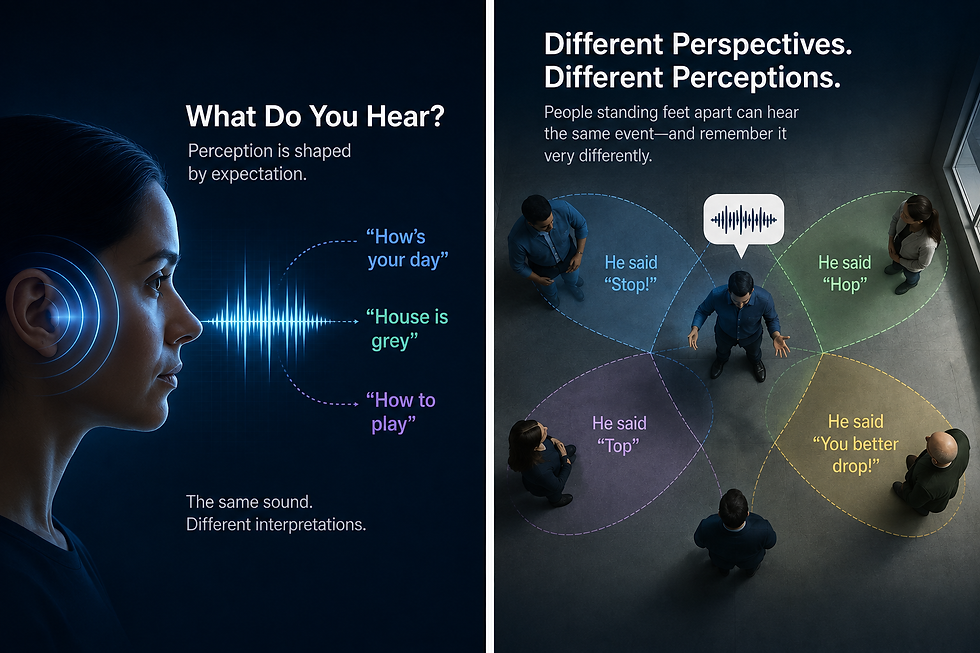
Memory retrieval occurs in the present. Even when an interview seeks to recreate the environmental, emotional, sensory, or cognitive context surrounding an earlier event, the interviewee is not returning to an untouched recording of the past. The person is attempting to retrieve an autobiographical representation from the memory system as it exists at the time of the interview.
That makes interview timing analytically important. A high-quality retrieval procedure conducted shortly after an event and before extensive outside exposure operates in a different informational environment from the same procedure conducted years later after treatment, multiple professional evaluations, family conversations, attorney interactions, record review, diagnostic explanations, media exposure, and earlier retrieval attempts.
The later interview may still produce accurate and valuable information. The scientific point is narrower: the retrieval procedure alone cannot establish the developmental history or source of every detail that is available at that later time.
A Cognitive Interview may improve access to the memory that exists at the time of retrieval; it cannot independently establish the developmental history of that memory.
Memory Retrieval History: Preserving the Developmental History of a Memory
Existing forensic practice provides many of the necessary building blocks: recording, collateral review, source comparison, contemporaneous documentation, and careful reporting. What is often missing is a single longitudinal structure showing how the critical autobiographical account developed across time and information exposure.
The Investigative Interview Institute therefore proposes two provisional organizational constructs for further scientific development.
A Memory Retrieval History (MRH) is not a history of whether a person's memory became better or worse. It is a source-controlled longitudinal record of the conditions under which consequential autobiographical information was retrieved, reported, exposed, interpreted, and subsequently re-retrieved.
The Retrieval, Exposure, and Source Matrix (RESM) is a proposition-level analytical structure used to trace the provenance, reference frame, elicitation conditions, intervening exposures, changes, interpretations, and independent evidentiary relationships of material autobiographical information across the Memory Retrieval History.
MRH and RESM are proposed I³ constructs, not established standardized forensic protocols. They do not compete with source-monitoring theory or existing forensic psychiatric practice. Their purpose is to operationalize those concerns longitudinally and transparently.
MRH and RESM are documentation and analytical-organization frameworks. They do not assign credibility, determine whether a memory is accurate or contaminated, diagnose a mental condition, or resolve an ultimate legal issue.
The chronology documents what can be established from the sources reviewed. It does not establish that an unrecorded or unavailable interaction did not occur, and it does not infer the content of a professional contact when the source does not describe that content.
For controlled use, MRH/RESM should distinguish Known, Not identified in reviewed sources, Source unavailable, Not applicable, and Pending review. Blank cells should not be permitted to carry multiple meanings.
Both Sides of the Interview Have an Information State
The interviewee is not the only person who enters an interview with prior knowledge. The interviewer also has an information state.
In the Clancy trial, prosecution evaluators described extensive pre-interview review of medical records, police investigative materials, digital evidence, prior expert reports, grand-jury material, and other collateral sources. That preparation can be essential to competent forensic evaluation. Analytically, it also means the later retrieval did not occur in an informationally blind environment.
MRH/RESM should therefore preserve two separate variables: the interviewee information state and the interviewer information state. Neither variable implies misconduct. Both help later reviewers understand the informational environment in which a particular question and answer occurred.
MRH Event Register and RESM Proposition Register
Event-level variables and proposition-level variables should not be mixed in one undifferentiated record. The MRH Event Register documents retrieval, exposure, and professional-contact events. The RESM Proposition Register traces individual material propositions across those events.
MRH Event Register answers:
What retrieval and exposure events occurred?
It records date, role, purpose, duration, preservation status, general retrieval method, interviewee information state, interviewer information state, and the level of event-related recall supported by the source.
RESM Proposition Register answers:
How did a particular material proposition appear, persist, change, become interpreted, or become corroborated across those events?
It records the verbatim or near-verbatim reported recollection, reference frame, prompt type, first known appearance, prior-account relationship, expressed confidence, intervening exposure, professional interpretation, and independent evidentiary relationships.
For future methodology development, C1, C2, and C3 require explicit operational definitions: C1 establishes professional contact; C2 establishes event-related autobiographical retrieval; C3 establishes sustained retrieval of the event sequence, material portions of it, or contemporaneous perceptions, thoughts, or actions beyond isolated questioning. C3 includes C2 and C1; C2 does not imply C3; duration or professional purpose alone never establishes C2 or C3; unknown remains unknown.
The Clancy Record Shows Why Contact Counts and Recall Counts Must Be Separated
Dr. Paul Zeizel testified that he first met with Clancy approximately eleven days after the deaths. He further testified that he had met with her more than 45 times by the time he prepared his report and approximately another 15 to 20 times afterward. The public trial record therefore supports approximately 60 or more professional contacts with this psychologist alone (Commonwealth v. Clancy, Day 15, 2026).
Approximately 60 contacts does not mean approximately 60 complete reconstructions of the event.
The public record does not establish that every meeting involved substantive episodic recall. Some contacts may have concerned mental-status examination, present functioning, treatment, legal preparation, clinical matters, or other issues. A contact count should therefore never be converted into a recall count without evidence.
Public trial materials support more than 70 professional-contact or evaluation-session entries across the post-event period when professional-person contacts are counted, dominated by approximately 60 reported contacts with one psychologist. This figure must not be interpreted as more than 70 unique sessions or retellings. The available public record does not establish how many contacts represented unique sessions, how many involved event-related recall, or how many involved substantial episodic reconstruction of the event.
The distinctions should remain explicit:
· A professional-contact count is not a unique-session count.
· A session count is not necessarily an event-related recall count.
· An event-related recall count is not necessarily a substantial episodic-reconstruction count.
An Important Absence in the Presently Reviewed Record
No substantive immediate law-enforcement interview of Clancy has been identified in the presently reviewed public trial record. Testimony concerning the immediate hospital period establishes police presence but does not presently establish a conventional substantive police interview with Clancy.
The correct formulation is therefore:
Law-enforcement interview: none identified in the presently reviewed public trial record.
“None identified” is intentionally different from “none occurred.” The distinction reflects a basic evidentiary principle: an absence in the materials reviewed should be preserved as a limitation rather than transformed into a factual conclusion.
If the presently available record is representative, the earliest substantive autobiographical accounts may have emerged primarily in clinical and defense-evaluation environments rather than in a conventional immediate investigative interview. That possibility is analytically relevant because each environment serves a different professional purpose.
Repeated Retrieval Changes the Analytical Landscape
Human memory is reconstructive. Retrieval can strengthen access to some information while changing the accessibility of related information. In an eyewitness-memory experiment, repeated questioning about selected crime-scene details improved later access to practiced details but impaired recall for some related, unpracticed details, even though the questioning contained no misinformation (Shaw et al., 1995).
Repeated exposure to post-event information adds another consideration. Foster et al. (2012) found that repetition of misleading claims increased both susceptibility to those claims and confidence in them, regardless of whether the repeated information appeared to come from one source or multiple sources.
These findings should not be oversimplified into a claim that repeated recall necessarily damages memory. Repeated retrieval can also support retention and can produce additional accurate information. The appropriate conclusion is that retrieval history is part of the evidentiary history of the later account.
Consistency likewise requires careful interpretation. A repeated account may be accurate and consistently retrieved. It may also be increasingly familiar because the same account has been rehearsed. Consistency is relevant evidence, but it is not a substitute for provenance.
Cumulative Exposure Is Broader Than Repeated Questioning
The number of interviews alone cannot describe a memory's post-event information environment. Between formal retrieval attempts, a person may encounter information from:
· therapists;
· physicians;
· family members;
· attorneys;
· investigators;
· previous interview recordings;
· medical records;
· police reports;
· expert reports;
· digital evidence;
· photographs or video;
· witness statements;
· legal pleadings;
· news coverage;
· social media;
· courtroom testimony;
· discussions of diagnosis;
· discussions of the meaning of symptoms;
· explanations offered by other people.
Every exposure need not be misleading to matter.
These exposures need not be inaccurate or suggestive to become analytically relevant. Their importance lies in identifying what information was available, when it became available, and whether its source can later be distinguished from direct episodic recollection.
Same factual conclusion, different source relationship:
“I remember the clock showing 6:10.”
Compared with:
“I know it was 6:10 because I later saw the phone record.”
Accurate post-event information can create a source question just as inaccurate information can. “I remember the clock showing 6:10” and “I know it was 6:10 because I later saw the phone record” may lead to the same factual conclusion while reflecting very different memory-source relationships.
For that reason, cumulative exposure should be documented as an information history rather than treated only as a contamination inquiry.
Clinical treatment and forensic memory preservation serve different professional purposes. The analytical relevance of a treatment encounter does not imply that the treatment was improper or suggestive. It means only that event-related information exchanged during treatment may become part of the individual's subsequent information environment and therefore may be relevant when evaluating the provenance of later autobiographical accounts.
The MRH records the cognitive and informational conditions under which recall occurred without presuming which condition, if any, affected accuracy. Where supported by the source, relevant state variables may include acute medical condition, medication, pain, sleep deprivation, delirium, sedation or recent sedation, fluctuating attention, neurological or physiological impairment, emotional distress, and psychiatric symptoms.
Source Monitoring: Remembering Information Is Not the Same as Remembering Its Origin
The Source Monitoring Framework describes the cognitive processes by which people attribute memories, knowledge, and mental experiences to particular origins (Johnson et al., 1993). A person may correctly retain content while becoming uncertain or mistaken about whether it was seen, heard, imagined, inferred, read, learned from another person, or acquired later.
Did I see it?
Did I hear it?
Did someone tell me?
Did I read it?
Did I infer it?
Did I imagine it?
Was it part of a dream?
Did I learn it afterward?
Source-monitoring errors occur when content is remembered but its origin is incorrectly attributed.
This becomes particularly important when an autobiographical account develops across treatment, evaluation, investigation, and litigation.
Consider a simple sequence:
Interviewee:
“I heard a man's voice.”
Later professional characterization:
“A command auditory hallucination.”
Later autobiographical description:
“I experienced a command hallucination.”
Those statements may ultimately refer to the same underlying historical experience, but scientifically they are not identical pieces of evidence.
· The first is a reported remembered experience.
· The second is a professional interpretation or classification.
· The third may represent independent autobiographical description, adoption of subsequently learned terminology, or some combination of memory and later conceptual understanding.
None of those possibilities proves that the original experience did or did not occur. They demonstrate why source and sequence matter.
Preserve Verbatim or Near-Verbatim Reported Recollection Separately From Interpretation
One of the strongest safeguards in a memory-history framework is to preserve the interviewee's words separately from professional interpretation.
The analytical progression is easier to see when the levels remain separated:
Reported recollection
“I heard somebody say, ‘You have to do this.’”
Summary
“She reported hearing a voice.”
Clinical interpretation
“She experienced an auditory hallucination.”
More specific clinical interpretation
“She experienced a command hallucination.”
Possible forensic interpretation
A later opinion may then connect the reported experience to a clinical or legal conclusion.
Each level adds something different. The critical control is to prevent later summaries, diagnostic terminology, or forensic conclusions from being mistaken for the interviewee's original reported language.
Ordinary narrative reports can unintentionally collapse these levels. Once collapsed, later reviewers may be unable to determine which words originated with the interviewee and which originated with clinicians, investigators, attorneys, or evaluators.
Preserving verbatim or near-verbatim reported recollection protects all sides of the analysis. It reduces the risk of attributing professional language to an interviewee, and it also preserves the evidentiary foundation on which a legitimate professional interpretation was based.
Reference Frame Deserves Its Own Field
The reference frame used by the interviewee can be as important as the content of the statement. Consider several statements about the same location:
· “I remember standing beside the refrigerator.”
· “I know I was there because I later saw the video.”
· “My husband told me I was there.”
· “I think I must have been there.”
The factual proposition may be similar, but the claimed source of knowledge is not.
The same distinction applies to internal experiences:
· “I remember hearing a voice.”
· “I now understand that experience as a hallucination.”
· “My psychiatrist explained that it was probably a hallucination.”
A memory-history record should therefore preserve whether a statement is presented as direct visual recollection, auditory recollection, bodily sensation, remembered thought, emotional recollection, inference, reconstructed chronology, information learned later, present interpretation of a past experience, or an uncertain or mixed source.
Psychosis Makes Source Monitoring Relevant, but Generalization Must Be Cautious
Source monitoring has been studied extensively in psychosis. A systematic review and meta-analysis of 44 studies found overall source-monitoring impairment in primary psychiatric psychosis, with particularly notable effects involving internal and imagined information (Damiani et al., 2022). Experimental work has also reported increased susceptibility to misleading information under social pressure in schizophrenia (Peters et al., 2012).
These findings cannot simply be transferred from one diagnostic population to another. Postpartum psychosis is not interchangeable with schizophrenia, and a diagnosis of psychosis does not establish that a particular autobiographical memory is inaccurate.
The defensible conclusion is narrower: when hallucinations, internally generated experiences, and retrospective autobiographical memory are materially relevant, source monitoring is a legitimate scientific issue to examine rather than assume.
The task is not to diagnose memory. It is to preserve enough provenance to allow qualified experts to evaluate competing explanations.
Retrospective Diagnosis and Memory Provenance Must Be Kept Conceptually Separate
Forensic psychiatric practice already recognizes the importance of collateral information, contemporaneous records, multiple information sources, and comparison of the evaluee's account against independent evidence when reconstructing a past mental state (American Academy of Psychiatry and the Law, 2014).
The proposed memory-history approach does not replace those practices. It operationalizes one component longitudinally: the developmental history of the remembered narrative itself.
When a retrospective diagnosis or forensic opinion depends materially upon a person's later autobiographical description of an earlier mental state, the provenance of that recalled information becomes relevant to evaluating the evidentiary basis of the opinion.
This does not mean repeated interviews invalidate a diagnosis. It does not mean a later recollection is necessarily false. It does not mean a forensic expert should disregard autobiographical memory. It means the account has a history, and that history may be relevant to the weight placed on particular propositions within the opinion.
The Goal Is Not to Prevent Repeated Interviews
Repeated professional contact is sometimes unavoidable and often necessary. Clinicians must treat patients. Physicians must assess safety and capacity. Investigators may need clarification. Retained experts may require independent evaluation. Opposing experts may appropriately test competing hypotheses.
The scientific response therefore cannot simply be “do not interview the person again.”
A more realistic principle is this: when consequential repeated recall occurs, preserve what happened during each retrieval and what happened between retrievals.
That principle converts an unavoidable human process into something that can later be examined rather than reconstructed from incomplete summaries.
Source Control, Versioning, and Independent Review
A reproducible MRH/RESM system requires source-level traceability. Each material entry should link to the exact underlying source and, where possible, to page and line, timestamp, exhibit locator, or other stable reference. Reported recollection and professional interpretation should be stored in separate fields.
Unknown states must remain controlled rather than being inferred. Corrections should preserve history through version, change date, prior value, new value, reason for change, and the source supporting the correction. The history of the analytical record should itself be auditable.
Future methodology validation should include independent second review, structured disagreement reconciliation, explicit coding rules, and inter-rater reliability testing for consequential proposition coding. MRH/RESM should expose provenance and analytical conditions; it should not generate a numerical “memory contamination score.”
Several safeguards emerge across clinical, legal, scientific, methodological, and process-control perspectives:
· Do not equate contact with recall.
· Do not equate recall with reconstruction.
· Do not equate consistency with accuracy.
· Do not equate a CI-associated technique with the Cognitive Interview.
· Do not equate retrieval with validation.
· Do not equate clinical interpretation with the interviewee’s original reported words.
· Do not equate information exposure with contamination.
· Do not equate psychosis with unreliable memory.
What the Lindsay Clancy Case Can Teach Us
The enduring scientific value of the Lindsay Clancy case may have little to do with whether one agrees with any particular expert. The record instead illustrates how a consequential autobiographical account can exist inside a complex information ecosystem containing treatment, multiple professional evaluations, collateral records, interpretation, and later comparison.
An event occurs. A person remembers it. Someone asks about it. The person remembers it again. Other information becomes available. Clinicians discuss it. Family members discuss it. Attorneys and experts examine it. Later evaluators compare the current account with earlier reports. Eventually the narrative may become detailed, coherent, and familiar.
But detail is not provenance, and retrieval is not historical verification.
The Cognitive Interview remains one of the most important scientifically grounded developments in investigative interviewing because it recognizes that the way we ask people to search memory matters. The Clancy case points toward an additional question: what happened to that memory before we asked?
When important decisions depend upon a memory that has been repeatedly retrieved by different professionals for different purposes, the memory itself needs a documented history.
That history should preserve:
· original or near-verbatim reported language;
· a clear separation between recollection and professional interpretation;
· the interviewee’s reference frame;
· cumulative information exposure;
· distinctions among professional contact, unique session, event-related recall, and substantial episodic reconstruction;
· the interviewee and interviewer information states;
· when consequential details first appeared and how they changed over time; and
· cross-correlation between recollection and independent evidence.
The purpose is not to decide for a court whether a memory is true, false, contaminated, or diagnostically valid. The purpose is to preserve the information necessary for qualified investigators, clinicians, forensic experts, researchers, attorneys, and courts to evaluate those questions transparently.
A Cognitive Interview may improve access to the memory that exists at the time of retrieval; it cannot independently establish the developmental history of that memory.
The difference is the difference between preserving a statement and preserving the history of a memory.
Companion Research Publications
The source-controlled research instruments supporting this publication are issued separately as:
· Research Exhibit A. Lindsay Clancy MRH Event Register — standalone research dataset publication.
· Research Exhibits B–C. RESM Proposition Register — Illustrative Structure and RESM Analytical Field Dictionary — standalone analytical-framework publication.
Separating the research exhibits from the narrative publication allows the registers and analytical structures to be reviewed, cited, and updated independently without altering the scientific discussion in the principal publication.
References
APA 7th edition. Primary case sources are listed separately from scientific literature so readers can distinguish empirical foundations from case-specific factual sources.
Scientific Literature
American Academy of Psychiatry and the Law. (2014). AAPL practice guideline for forensic psychiatric evaluation of defendants raising the insanity defense. Journal of the American Academy of Psychiatry and the Law, 42(4 Suppl.), S3–S76. https://pubmed.ncbi.nlm.nih.gov/25492121/
Damiani, S., Donadeo, A., Bassetti, N., Salazar-de-Pablo, G., Guiot, C., Politi, P., & Fusar- Poli, P. (2022). Understanding source monitoring subtypes and their relation to psychosis: A systematic review and meta-analysis. Psychiatry and Clinical Neurosciences, 76(5), 162–171. https://doi.org/10.1111/pcn.13338
Fisher, R. P., & Geiselman, R. E. (1992). Memory-enhancing techniques for investigative interviewing: The cognitive interview. Charles C Thomas.
Foster, J. L., Huthwaite, T., Yesberg, J. A., Garry, M., & Loftus, E. F. (2012). Repetition, not number of sources, increases both susceptibility to misinformation and confidence in the accuracy of eyewitnesses. Acta Psychologica, 139(2), 320–326. https://doi.org/10.1016/j.actpsy.2011.12.004
Geiselman, R. E., Fisher, R. P., MacKinnon, D. P., & Holland, H. L. (1985). Eyewitness memory enhancement in the police interview: Cognitive retrieval mnemonics versus hypnosis. Journal of Applied Psychology, 70(2), 401–412. https://doi.org/10.1037/0021-9010.70.2.401
Johnson, M. K., Hashtroudi, S., & Lindsay, D. S. (1993). Source monitoring. Psychological Bulletin, 114(1), 3–28. https://doi.org/10.1037/0033-2909.114.1.3
Memon, A., Meissner, C. A., & Fraser, J. (2010). The cognitive interview: A meta-analytic review and study space analysis of the past 25 years. Psychology, Public Policy, and Law, 16(4), 340–372. https://doi.org/10.1037/a0020518
Peters, M. J. V., Moritz, S., Tekin, S., Jelicic, M., & Merckelbach, H. (2012). Susceptibility to misleading information under social pressure in schizophrenia. Comprehensive Psychiatry, 53(8), 1187–1193. https://doi.org/10.1016/j.comppsych.2012.04.008
Shaw, J. S., III, Bjork, R. A., & Handal, A. (1995). Retrieval-induced forgetting in an eyewitness-memory paradigm. Psychonomic Bulletin & Review, 2(2), 249–253. https://doi.org/10.3758/BF03210965
Tulving, E., & Thomson, D. M. (1973). Encoding specificity and retrieval processes in episodic memory. Psychological Review, 80(5), 352–373. https://doi.org/10.1037/h0020071
Where official court transcripts, admitted exhibits, or certified records become available, those sources should supersede unofficial public transcripts for the controlled dataset. Public transcript services are treated here as reproductions of primary testimony, not as certified court transcripts.
Publicly Available Trial-Testimony Sources
Commonwealth v. Lindsay Clancy, Day 15. (2026). Trial transcript [Transcript]. Rev. https://www.rev.com/transcripts/ma-v-lindsay-clancy-day-15
Commonwealth v. Lindsay Clancy, Day 18. (2026). Trial transcript [Transcript]. Rev. https://www.rev.com/transcripts/ma-v-lindsay-clancy-day-18
Commonwealth v. Lindsay Clancy, Day 19. (2026). Trial transcript [Transcript]. Rev. https://webflow.rev.com/transcripts/ma-v-lindsay-clancy-day-19
Commonwealth v. Lindsay Clancy, Day 20. (2026). Trial transcript [Transcript]. Rev. https://webflow.rev.com/transcripts/ma-v-lindsay-clancy-day-20
Secondary Case Sources Used for Qualified Chronology Entries
Public reporting concerning Dr. Margaret Spinelli's 2024 evaluation dates and durations is used only where the presently reviewed primary trial record did not provide direct confirmation. Those entries are expressly labeled as secondary-source supported in Research Exhibit A.
Hidden True Crime. (2026). Lindsay Clancy deep dive | Everything you need to know ahead of the trial—Murder or mentally ill? [Podcast transcript]. Podscripts. https://podscripts.co/podcasts/hidden-true-crime/lindsay-clancy-deep-dive- everything-you-need-to-know-ahead-of-the-trial-murder-or-mentally-ill
Associated Press. (2026, August 29). As jurors deliberate in the Lindsay Clancy trial, here are key moments they may be considering. https://apnews.com/article/7e3d5aca36b47a1676b63dd3716eb5c0
Methodological status note: MRH and RESM are proposed I³ organizational constructs. They should not be represented as validated forensic protocols unless and until they undergo formal methodology development and empirical evaluation.


Comments