
Better Questions, Better Clinical Information

Updated: Jul 6
Applying Open-Ended Interviewing Principles to Clinical Intake
Clinical intake is an information-gathering process.
Whether the setting is a physician’s office, hospital, urgent care center, specialty clinic, or other healthcare environment, clinicians and intake professionals must obtain information that may directly affect assessment, treatment, medication selection, and patient safety.
They must often do so under substantial time pressure.
Electronic health-record systems require specific fields to be completed. Intake professionals may be working from standardized prompts displayed on a screen. Questions about medications, symptoms, medical history, prior procedures, and allergies may appear as individual boxes that must be answered before the encounter can proceed.
These systems serve important purposes. Standardization promotes consistency, supports documentation, and helps ensure that essential topics are not overlooked.
However, a completed checkbox is not necessarily the same as complete information.
The wording of a question can affect what a patient understands, searches for in memory, and ultimately reports. A small change in language may therefore produce a meaningful change in the quality of the information obtained.
Consider the following common intake question:
“You don’t have any known allergies?”
The question may appear efficient. It may also reflect language transferred almost automatically from an electronic intake screen. Yet its structure creates several information-gathering problems.
The purpose of examining this question is not to criticize the nurse, medical assistant, clinician, or other professional asking it. Most healthcare professionals are performing demanding work within highly structured systems.
The more useful question is:
How can clinical professionals obtain better information by asking better questions?

The Problem With a Negatively Framed Question
“You don’t have any known allergies?” is a closed and negatively framed question.
It communicates an expected answer before the patient responds. The phrase “you don’t” suggests that the anticipated answer is “no.” It also allows the patient to confirm the proposition without independently searching memory and describing relevant experiences.
A patient may interpret the question as:
“The record says I have no allergies. Is that correct?”
“The nurse expects me to say no.”
“They are asking only about formally diagnosed allergies.”
“They probably do not need details.”
“This is simply another intake checkbox.”
The patient may answer “no” while remembering a rash, swelling, breathing difficulty, dizziness, nausea, or another reaction that the patient does not personally classify as an allergy.
This does not necessarily mean the patient is withholding information. The question may simply fail to prompt the relevant memory.
Closed questions are not inherently inappropriate in healthcare. They are often necessary for clarification, confirmation, and risk screening. The problem arises when a closed or leading question is used before the patient has been given a meaningful opportunity to provide an independent account.
A Question Is Also a Retrieval Cue
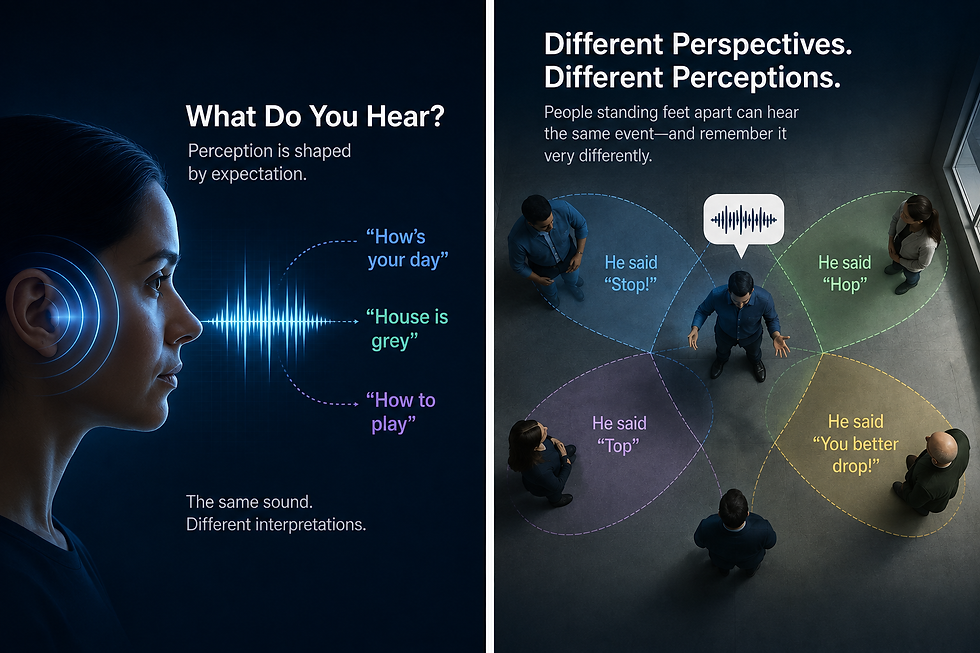
Human memory does not operate like a complete recording that can be accessed identically by every question.
A question acts as a retrieval cue. Its wording helps determine:
what information the person searches for,
how broadly or narrowly the person searches,
what category the person believes is relevant,
and how much detail the person believes the interviewer wants.
A narrowly framed question tends to produce a narrowly framed response.
An open invitation allows the patient to search memory using personal experiences, language, and associations. Research in medical interviewing has found that open-ended questions can produce more information, even during brief encounters.
The goal is not to turn every intake question into a lengthy discussion. It is to begin important topics broadly enough to identify relevant information and then narrow the inquiry efficiently.
Open First, Then Focus
A practical clinical information-gathering sequence can be organized into three stages.
1. Open Invitation
Begin with a question that does not communicate the desired answer.
Examples include:
“What allergies, sensitivities, or previous reactions are you aware of?”
“Tell me about any allergies or reactions you have experienced.”
“What medications, foods, substances, or materials have caused a reaction for you?”
These questions allow the patient to identify what is personally meaningful without being limited immediately to a yes-or-no response.
2. Focused Exploration
Once the patient identifies a possible allergy or reaction, the interviewer can obtain the clinically relevant details.
Examples include:
“Please describe what happened.”
“How soon after the exposure did the reaction begin?”
“What treatment, if any, was needed?”
“When did this occur?”
“Has it happened more than once?”
The patient should not be expected to determine whether the event was technically an allergy, side effect, intolerance, sensitivity, or adverse reaction. The patient’s role is to describe the experience. The clinician’s role is to evaluate its significance.
3. Closed Verification
Closed questions can then be used to confirm specific details and complete required documentation.
Examples include:
“Did the reaction involve difficulty breathing?”
“Did it require emergency treatment?”
“Was penicillin the medication involved?”
“Are there any other medications, foods, adhesives, latex products, or environmental substances that have caused a reaction?”
This open-to-focused sequence combines patient-centered information gathering with the structured requirements of clinical practice.
Better Alternatives to Common Intake Questions
The same principle applies throughout clinical intake.
Instead of:
“You don’t have any known allergies?”
Consider:
“What allergies, sensitivities, or previous reactions are you aware of?”
Instead of:
“Nothing has changed since your last visit?”
Consider:
“What has changed since your last visit?”
Instead of:
“Do you have any questions?”
Consider:
“What questions do you have?”
These revisions are simple, but they reflect an important change in method. The interviewer is no longer presenting an expected answer for the patient to confirm. The patient is invited to search memory, describe relevant experiences, and identify information that may not be captured by a narrowly framed question.
Open-ended questions should not replace every structured or closed question. They should create the initial opportunity for recall before focused clarification and verification begin.
Allow the Patient to Complete the Initial Response
Open-ended questions are effective only when the patient is permitted to answer them.
Research on clinical encounters has repeatedly shown that patients are often interrupted during their opening statements. This does not mean that clinicians must listen indefinitely without structure. Clinical interviewing still requires direction, prioritization, and time management.
A practical approach is:
Invite the patient’s account.
Listen without prematurely narrowing it.
Identify the important topics.
Summarize what was heard.
Prioritize what can be addressed during the encounter.
Ask focused questions to obtain the necessary details.
Identifying the patient’s concerns early may be more efficient than repeatedly redirecting the conversation before those concerns are understood.
Open-Ended Does Not Mean Unstructured
A common concern is that open-ended questions will make intake too long.
That concern deserves serious recognition. Clinical professionals work under real scheduling, documentation, staffing, and workload constraints. A method that ignores those realities is unlikely to be used consistently.
However, open-ended interviewing does not require every question to remain broad. Nor does it require abandoning forms, electronic prompts, screening tools, or safety checklists.
The more practical sequence is:
The OLCCD Model™ Open first. Listen. Clarify. Confirm. Document.

The open question identifies the information.
Focused questions define it.
Closed questions verify it.
The electronic record documents it.
Efficiency should therefore be measured not only by how quickly a box is completed, but also by whether the information entered into that box is accurate, sufficiently complete, and clinically useful.
The Screen Should Support the Conversation
Electronic health records are designed to organize information. They should not determine the entire character of the interaction.
When a screen displays “Allergies: Yes/No,” the clinician must convert that field into a question. That conversion is not merely administrative. It is an interviewing decision.
A better workflow might begin with:
“What allergies, sensitivities, or previous reactions are you aware of?”
The system could then provide structured fields for:
the substance or medication,
the type of reaction,
the approximate date,
the severity,
and any treatment required.
This preserves the value of structured data while improving the quality of the conversation used to obtain it.
The patient should not be treated as a database from which isolated fields are extracted. The patient is the source of a personal history that must be understood before it can be accurately categorized.
Rapport Supports Information Quality
Patients may hesitate to report information because they:
believe a symptom is unimportant,
fear appearing difficult,
feel embarrassed,
misunderstand the question,
lack medical terminology,
assume the clinician already knows,
or believe that a detailed response will delay the appointment.
Brief statements can reduce these barriers.
Examples include:
“Please use your own words.”
“Take a moment to think about it.”
“Even if you are unsure whether it was an allergy, please describe what happened.”
“I may ask some specific follow-up questions after you finish.”
These statements clarify the process and reassure the patient that a polished medical explanation is not required.
A Practical Allergy-Question Sequence
A concise and clinically usable sequence might be:
Initial invitation
“What allergies, sensitivities, or previous reactions are you aware of?”
Experiential expansion
“Tell me what happened when you were exposed to each one.”
Category prompts
“Have you experienced reactions to any medications, foods, latex, adhesives, contrast materials, or environmental substances?”
Clinical details
“What symptoms occurred?”
“How quickly did they begin?”
“What treatment was required?”
“When did this last happen?”
Final completeness check
“What else have you reacted to that we have not discussed?”
Verification
“Have I recorded this accurately?”
The sequence can be shortened or expanded according to the setting and level of risk.
This Is a Systems Issue, Not an Individual Criticism
Healthcare professionals routinely work within systems they did not design.
They may be required to complete extensive documentation, maintain patient flow, respond to interruptions, coordinate with multiple professionals, and address immediate safety concerns.
It would therefore be unfair and unproductive to attribute every poorly phrased question to a lack of professionalism or concern.
The more constructive approach is to examine the design of clinical information gathering.
Do electronic forms encourage negatively framed questions?
Do intake scripts begin with confirmation rather than recall?
Are clinicians trained to open broadly and then narrow?
Do workflows provide patients with a meaningful opportunity to describe experiences in their own words?
Does the system reward completed fields more visibly than complete understanding?
These are questions of design, training, and institutional practice.
From Individual Questions to Institutional Practice
Improving clinical information gathering requires more than replacing a few phrases.
Hospitals, clinics, and healthcare systems may benefit from evaluating:
how electronic prompts are converted into spoken questions,
whether intake scripts unintentionally communicate expected answers,
how open-ended and focused questions are sequenced,
whether patients are given sufficient opportunity to complete an initial response,
and how accurately patient language is translated into the medical record.
The Investigative Interview Institute® applies evidence-based interviewing principles to professional information-gathering environments, including clinical intake and patient communication.
Through the Evidence-Based Clinical Interview Method™ (EBCIM), I³ can assist healthcare organizations with:
clinical intake and workflow evaluation,
interview-question design,
customized staff training,
scenario-based instruction,
organizational consulting,
and development of evidence-based clinical information-gathering practices.
The objective is not to increase the burden placed on clinicians. It is to help healthcare professionals obtain more complete, accurate, and clinically useful information within the operational realities of modern healthcare.
Hospitals, clinics, and healthcare systems interested in EBCIM training, intake evaluation, or organizational consulting may contact the Investigative Interview Institute® to discuss their clinical information-gathering needs.
Better Questions Protect More Than Rapport
Question quality is sometimes treated as a matter of courtesy or bedside manner. It is more than that.
Question format can affect:
the completeness of the medical history,
recognition of medication reactions,
symptom description,
risk identification,
the completeness of infectious-disease exposure information,
treatment decisions,
patient understanding,
and the accuracy of the permanent health record.
The principles of evidence-based interviewing therefore have relevance far beyond criminal investigations.
Clinical professionals, investigators, attorneys, educators, and other information-gathering professionals share a foundational responsibility:
Obtain the person’s account before replacing it with the interviewer’s assumptions.
Conclusion
The question:
“You don’t have any known allergies?”
may be intended only to complete a required intake field.
But its structure communicates an anticipated answer and limits the patient’s opportunity to independently search memory and describe relevant experiences.
A better approach begins with an open invitation:
“What allergies, sensitivities, or previous reactions are you aware of?”
It then proceeds to focused exploration and closed verification.
This is not an argument against electronic records, structured intake, standardized questions, or efficient clinical workflow. Each is necessary.
It is an argument for sequencing them more effectively.
The screen identifies the information that must be collected.
The interviewer creates the conditions under which that information can be recalled.
The patient provides the experience.
The clinician evaluates its significance.
Better clinical information does not always require more questions.
It often begins with a better first question.
References
Beckman, H. B., & Frankel, R. M. (1984). The effect of physician behavior on the collection of data. Annals of Internal Medicine, 101(5), 692–696.
Marvel, M. K., Epstein, R. M., Flowers, K., & Beckman, H. B. (1999). Soliciting the patient’s agenda: Have we improved? JAMA, 281(3), 283–287.
Mulder-Vos, I., et al. (2023). Observational study on the timing and method of interruptions during patients’ opening statements in general practice. BMJ Open, 13, e066678.
Takemura, Y., et al. (2005). Open-ended questions: Are they really beneficial for gathering medical information from patients? Tohoku Journal of Experimental Medicine, 206(2), 151–154.


Comments