
Memory, Spatial Context, Visual Search, and the Importance of Communication in Investigative Interviewing
- Michael Albin

- Jul 6
- 7 min read
Updated: 4 days ago
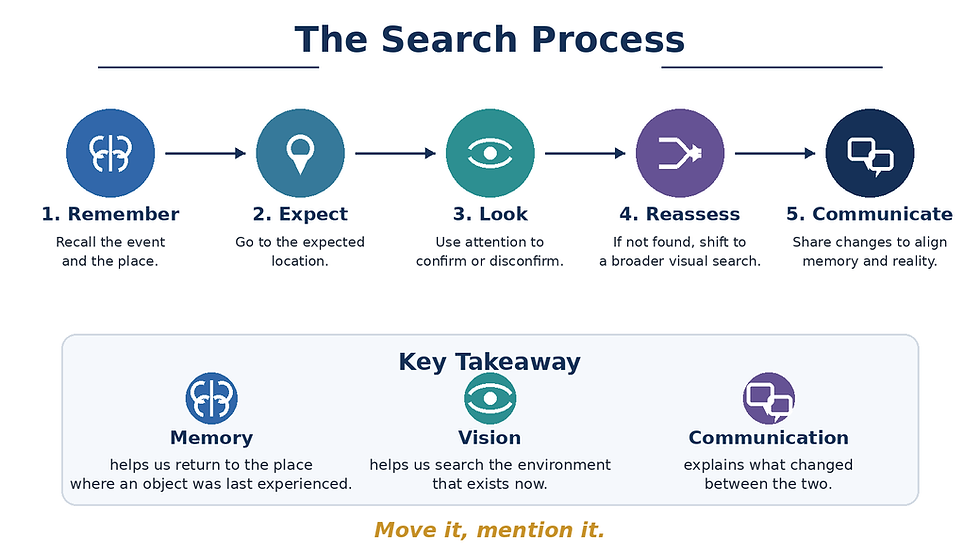
Most people have experienced a familiar moment: you are ready to leave the house, but your keys are missing. You check the counter where you normally place them. You look beside the door, on the kitchen table, and near the chair where you last remember sitting. You may retrace your movements, mentally reconstruct the previous evening, or return repeatedly to a location you have already searched.

Then someone says:
“I found them earlier and moved them to a better place.”
The keys were not necessarily forgotten in the ordinary sense. The location remembered by one person no longer matched the location created by another. This everyday problem offers a useful illustration of how memory, spatial representation, visual attention, and communication interact.
Understanding Memory and Spatial Context
When we try to remember where we left an object, we are rarely retrieving only the object itself. We may also retrieve:
The room we were in
The surface where the object was placed
The direction we were facing
What we were doing
What happened immediately before or afterward
Other objects that were nearby
Memory for an event is often connected to its spatial context. Research concerning place cells and grid cells has shown that the brain represents location, movement, and spatial relationships in ways that contribute to navigation and memory. Place-cell activity has also been associated with recalling the spatial context in which events and objects were experienced.
This helps explain why searching for lost keys often begins with a mental reconstruction:
“I came through the door, placed the mail on the counter, took off my coat, and set my keys beside the bowl.”
The remembered sequence provides a route back to the remembered location.
A Thousand Brains and Location-Based Knowledge
In A Thousand Brains, Jeff Hawkins proposes that location-based reference frames may be fundamental not only to navigation but also to how the neocortex learns objects and their relationships. Hawkins and colleagues have proposed that cortical columns may learn models of objects through movement and represent features according to their locations relative to those objects. Under this theory, the brain does not merely recognize a coffee cup as a collection of visual features; it also learns where the handle, rim, base, and other features are positioned in relation to one another.
An important scientific distinction is necessary. Place cells in the hippocampal system and grid cells in the entorhinal cortex are well-established findings. Hawkins’s broader proposal that grid-cell-like reference-frame mechanisms operate throughout the neocortex remains a scientific theory rather than a settled conclusion. Even with that qualification, the theory provides a useful way to consider an ordinary experience: our knowledge of an object may be connected to where we encountered it within a familiar space.
Searching Begins With an Expectation
When looking for a missing item, we usually do not search the entire house randomly. We begin where memory tells us the item is likely to be. The kitchen counter receives attention before the linen closet because the remembered context directs the search. Familiar spatial arrangements can guide visual attention and improve search efficiency. Research on contextual cueing has demonstrated that learned relationships between a visual layout and a target location can help people find targets more efficiently, even when they cannot explicitly describe everything they have learned about the arrangement.
In everyday terms, the room itself becomes part of the search cue. The bowl by the door, the stack of mail, and the edge of the counter help define where the keys should appear. When the keys remain in that expected location, memory and vision work together:
Memory identifies the likely place.
Attention is directed toward that place.
Vision confirms whether the object is present.
What Happens When Someone Moves the Object?
Now consider what happens when another person finds the keys in an unusual location.

The person may reasonably think:
“These do not belong here. I will place them somewhere safer.”
That action changes the environment, but it does not change the owner’s memory. The owner still remembers the keys in Location A. The keys are now in Location B. This creates a mismatch between the remembered world and the current world. The owner may repeatedly return to Location A because the memory feels specific and credible. After the expected location has been searched, the task changes. The person can no longer rely primarily on remembered placement and must conduct a broader visual search.
Instead of asking:
“Where did I put my keys?”
the practical question becomes:
“Where might someone else have placed my keys?”
That is a very different search problem.
From Memory-Guided Search to Visual Search
A memory-guided search is relatively focused. It is directed toward locations associated with the person’s recent actions and habits. A broader visual search requires the person to:
Inspect more locations
Shift attention among competing objects
Consider locations that do not match the original memory
Resist returning repeatedly to the most strongly remembered place
The moved object may also be difficult to detect because the new location lacks the context associated with it. Keys placed beside a wallet near the door are expected. The same keys placed on a bookshelf, under a folded towel, or inside a drawer may not attract attention as readily. The object is physically visible, but it may not be where attention is directed. This distinction is important:
Available to vision does not always mean selected by attention.
The Communication Problem
The second person may have intended to help. The difficulty arises because the physical action was not accompanied by communication. A brief statement could preserve the usefulness of the original memory:
“I found your keys on the kitchen counter and moved them to the table beside the door.”
That statement does several things:
Identifies the original location
Explains why the person’s memory pointed there
Provides the new location
Prevents unnecessary searching
Without that communication, the owner may begin to distrust an otherwise accurate memory. The person may think:
“I was certain I left them there.”
That certainty may have been justified. The environment changed after the memory was formed.
A Practical Household Principle
When moving an object that another person may later need, use a simple rule:
Move it, mention it.
Better still, preserve both locations in the explanation:
“I found it here, and I moved it there.”
This small act of communication links the remembered location with the current location. It also avoids an unnecessary disagreement in which one person insists, “I left it on the counter,” while the other responds, “No, it was beside the door.” Both statements may describe different moments accurately.
Cognitive Interview and Memory Recall
The familiar experience of losing one’s keys also illustrates why the Cognitive Interview can support memory recall. An interviewer who understands that memories are often linked to visual details, spatial layouts, place-cell and grid-cell activity, and location-based reference frames can help a person mentally reinstate the setting in which an event occurred.
By inviting the interviewee to describe what they saw, where objects and people were positioned, how they moved through the space, and what changed before or after the event, the interviewer may provide retrieval cues that assist access to location-specific memories. Clear communication remains essential: the interviewer should avoid supplying the remembered location and instead help the person reconstruct it through their own observations, movements, and spatial experience.
The Role of Memory in Investigative Interviewing
Memory plays a crucial role in investigative interviewing. Understanding how memory works can significantly enhance the effectiveness of interviews. When interviewers grasp the connection between memory and spatial context, they can better guide interviewees to retrieve accurate information. This understanding can lead to more reliable testimonies and improved outcomes in investigations.
Techniques for Enhancing Memory Recall
To enhance memory recall during interviews, several techniques can be employed:
Context Reinstatement: Encourage the interviewee to mentally return to the scene of the event. This can help trigger memories associated with that specific environment.
Open-Ended Questions: Use open-ended questions to allow the interviewee to provide detailed accounts. This approach encourages them to share more information than closed questions would.
Encouraging Visualization: Ask the interviewee to visualize the event in detail. This can help them access memories that may not be immediately available.
Avoiding Leading Questions: Leading questions can distort memories. It's essential to allow the interviewee to express their recollections without bias.
Building Rapport: Establishing a comfortable environment can help interviewees feel safe to share their memories. Building trust is crucial for effective communication.
Conclusion
Finding a misplaced object is not merely a test of whether memory is good or bad. It may require the brain to reconstruct an event, retrieve spatial context, direct attention toward a likely location, and compare the remembered environment with the environment that now exists. When another person moves the object without communicating the change, memory and reality temporarily diverge. The original memory may still be accurate, but it no longer predicts where the object can be found.
The lesson is simple: memory helps us return to the place where an object was last experienced. Vision helps us search the environment that exists now. Communication explains what changed between the two. And sometimes, the answer to “Where did I leave my keys?” is:
“Exactly where you remembered—before someone moved them.”
References
Chun, M. M., & Jiang, Y. (1998). Contextual cueing: Implicit learning and memory of visual context guides spatial attention. Cognitive Psychology, 36(1), 28–71.
Hawkins, J., Ahmad, S., & Cui, Y. (2017). A theory of how columns in the neocortex enable learning the structure of the world. Frontiers in Neural Circuits, 11, 81.
Hawkins, J., Lewis, M., Klukas, M., Purdy, S., & Ahmad, S. (2019). A framework for intelligence and cortical function based on grid cells in the neocortex. Frontiers in Neural Circuits, 12, 121.
Moser, M.-B., Rowland, D. C., & Moser, E. I. (2015). Place cells, grid cells, and memory. Cold Spring Harbor Perspectives in Biology, 7(2), a021808.


Comments