
Artificial Intelligence, Body-Worn Camera Narratives, and Memory Integrity

Human Factors, Associative Memory Architecture, and the Risk of AI-Assisted Memory Contamination in Police Reporting and Testimony
Artificial intelligence is rapidly entering modern policing. Agencies increasingly utilize artificial intelligence (AI) systems to transcribe body-worn camera (BWC) recordings, summarize events, assist with report generation, and reduce administrative workload. These technologies offer substantial operational advantages, including improved efficiency, searchable documentation, reduced officer report-writing burden, and enhanced investigative organization. Properly implemented, AI-assisted documentation systems may improve productivity without compromising ethics, integrity, or transparency.
However, the introduction of AI-generated narratives into critical incident reporting raises an important human-factors concern that has received comparatively little scientific attention: the potential contamination or alteration of officer memory through exposure to AI-generated post-event information prior to the preservation of the Officer’s independent recollection.
This concern is not rooted in opposition to artificial intelligence. Rather, it emerges from decades of peer-reviewed research demonstrating that human memory is reconstructive, associative, and vulnerable to post-event contamination. The issue is not merely whether the AI transcript is accurate. The more significant forensic and psychological question is whether the officer’s later recollection, written report, deposition testimony, or trial testimony becomes a blended product of direct perception, original memory, body-worn camera review, AI-generated narrative structure, and subsequent reconstruction.
The scientific literature surrounding memory contamination, source-monitoring error, attentional limitations, and associative memory architecture strongly suggests that exposure to AI-generated narratives prior to documenting an independent recollection may alter later memory retrieval and testimonial confidence. This issue is particularly important in law enforcement encounters because critical incidents frequently occur under conditions of elevated stress, rapid temporal compression, selective attention, perceptual narrowing, uncertainty, and high cognitive load.
The purpose of this article is not to argue against AI-assisted policing technologies. Instead, it is to advocate for a scientifically informed framework that balances technological advancement with the preservation of memory integrity, evidentiary reliability, and ethical investigative practice.

Human Memory Is Not a Video Recording
One of the most persistent misconceptions in legal and investigative environments is the belief that human memory functions like a video recorder. Decades of cognitive neuroscience research refute this assumption.
Human episodic memory is dynamic and reconstructive rather than reproductive (Moscovitch et al., 2016). Memories are not stored as complete objective recordings of experience. Instead, memories are reconstructed during retrieval through the interaction of sensory fragments, contextual information, semantic associations, emotional states, attentional priorities, and post-event information.
The hippocampus plays a central role in binding distributed sensory and contextual information into coherent episodic memories (Yassa & Stark, 2011). This architecture allows the brain to efficiently reconstruct incomplete experiences through associative retrieval mechanisms. However, the same associative architecture that makes memory adaptive also creates vulnerability. Later information can become associated with the original event and subsequently misattributed as firsthand recollection.
This distinction is critical in the context of AI-generated police narratives.
When an officer reads an AI-generated transcript or report summary after a critical incident, the officer is not simply “reviewing documentation.” The AI narrative functions as a powerful retrieval cue capable of reactivating and reshaping stored memory representations. The officer may later experience portions of the AI-generated narrative as subjectively familiar and may become unable to reliably distinguish between:
what was directly perceived,
what was inferred,
what was learned from reviewing the body-worn camera,
what was introduced through AI-generated summarization,
and what was reconstructed during later recollection.
Associative Memory Architecture and Source-Monitoring Errors
Research concerning source monitoring is particularly relevant to AI-assisted police reporting.
Johnson, Hashtroudi, and Lindsay (1993) described source monitoring as the cognitive process by which individuals determine the origin of remembered information. Individuals must distinguish whether information originated from direct perception, imagination, inference, conversation, media exposure, or external suggestion.
Source-monitoring failures occur when individuals confuse the source of remembered information while maintaining confidence in the memory itself. Importantly, the problem is not deception. The individual may genuinely believe the reconstructed memory reflects direct experience.
This becomes especially important when AI-generated narratives are reviewed shortly after emotionally significant or high-stress incidents.
AI-generated narratives possess several characteristics known to increase source-monitoring vulnerability:
narrative coherence,
authoritative presentation,
linguistic fluency,
chronological organization,
semantic consistency,
and technological credibility.
These characteristics may increase the subjective familiarity and perceived reliability of the information, making later source distinction more difficult.
An officer may later testify with complete sincerity while unknowingly blending:
original perception,
AI-generated wording,
body-worn camera information,
and post-event reconstruction.
The Misinformation Effect and Memory Contamination
The foundational work of Elizabeth Loftus demonstrated that post-event information can alter memory recall through what became known as the misinformation effect (Loftus, 2005).
Participants exposed to misleading post-event information frequently incorporated that information into later recollections. Importantly, confidence in contaminated memories often remained high even when the memories were inaccurate.
Julia Shaw’s work further demonstrated the malleability of autobiographical memory and the capacity for rich false memories to emerge through suggestion, narrative reinforcement, and social influence (Shaw & Porter, 2015).
These findings are highly relevant to AI-assisted report generation.
The concern is not limited to overt transcription error or hallucinated content. Even an accurate AI-generated transcript may contain information that the officer:
did not consciously attend to,
did not perceptually process,
did not encode into memory,
or did not independently remember.
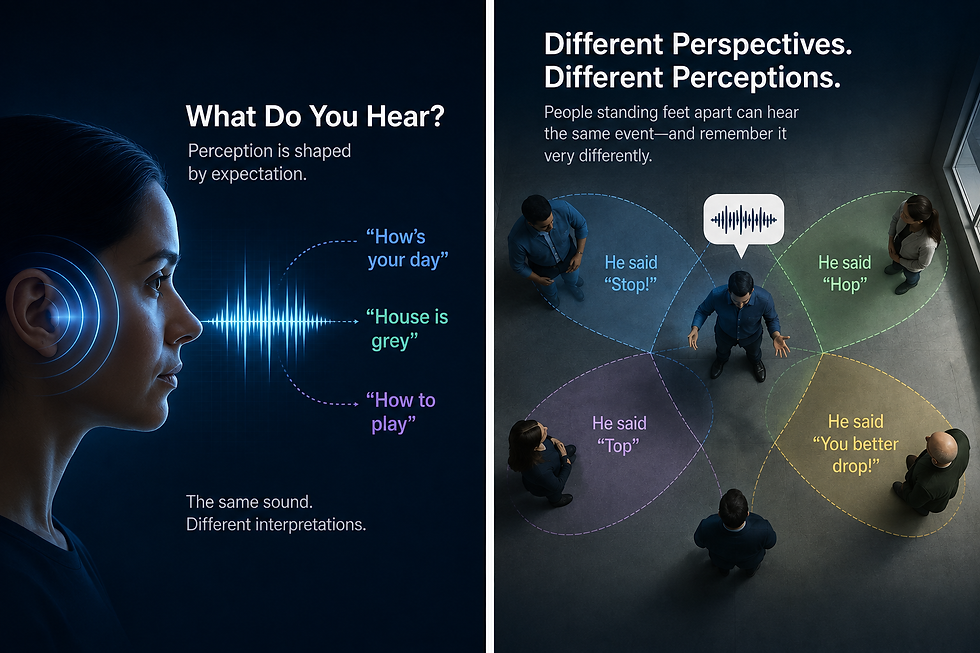
Body-worn cameras record indiscriminately. Human attention does not.
The officer may become aware of statements, sounds, movements, or environmental details that were outside the officer’s attentional focus during the incident. Once incorporated into post-event review, these details may later become psychologically integrated into the officer’s reconstructed memory.
This phenomenon becomes especially concerning because individuals are often unaware that memory contamination has occurred.
Attention, Perception, and Cognitive Load During Critical Incidents
Human attention is selective and capacity-limited. Under conditions of threat, uncertainty, and elevated stress, attentional resources become prioritized toward behaviorally relevant stimuli.
Research involving inattentional blindness, selective attention, and attentional tunneling demonstrates that individuals frequently fail to perceive information that is objectively visible when attentional resources are allocated elsewhere (Simons & Chabris, 1999).
Police encounters often involve:
rapidly evolving threats,
divided attention,
auditory overload,
visual uncertainty,
movement,
low-light conditions,
competing sensory demands,
and compressed decision-making timelines.
Under such conditions, officers may not consciously process all information later observable or heard in recorded media.
This distinction is fundamental.
The body-worn camera records optical and auditory data. The officer experiences a selective, attention-filtered, stress-mediated perceptual event.
These are not identical systems.
Accordingly, exposure to AI-generated narratives derived from recorded media may introduce post-event information that was never consciously perceived during the original encounter.
Body-Worn Cameras Are Not Human Perception
Body-worn cameras are valuable investigative tools, but they are not surrogates for human perception.
Prior human-factors research involving body-worn cameras has identified numerous limitations, including:
parallax differences,
lens distortion,
limited dynamic range,
exposure adaptation,
rolling shutter artifacts,
frame-rate limitations,
low-light degradation,
and differences between monocular recording and binocular human vision.
Equally important are the cognitive differences between recording and perception.
Cameras record continuously within technical limitations. Human beings perceive selectively based upon:
attentional allocation,
expectation,
prior experience,
emotional salience,
threat prioritization,
and cognitive workload.
Consequently, the presence of information within recorded media does not establish that the officer consciously perceived, interpreted, or cognitively processed that information during the incident.
AI-generated narratives derived from body-worn camera recordings may therefore create the false impression that the officer possessed a more comprehensive awareness than was psychologically possible during the event itself.
AI-Assisted Reporting and Trial Testimony
The legal implications of AI-assisted report generation may become substantial.
Cross-examination may increasingly focus on:
when the officer reviewed AI-generated material,
whether the officer completed an independent recollection first,
whether the AI narrative altered later memory,
whether the officer can distinguish firsthand memory from post-event exposure,
and whether AI-generated language influenced testimony.
The central issue becomes one of memory provenance.
A future cross-examination question may be straightforward:
“Officer, are you testifying from your independent memory of the event, or from the AI-generated narrative you reviewed afterward?”
This question directly implicates:
source-monitoring reliability,
memory contamination,
testimonial independence,
and evidentiary integrity.
Importantly, the officer may be entirely sincere while still being unable to separate original perception from AI-assisted reconstruction.
A Scientifically Defensible Framework
The scientific literature does not support rejecting artificial intelligence in policing. Properly implemented, AI may substantially improve efficiency, organization, consistency, and documentation.
However, human-factors science strongly supports sequencing safeguards designed to preserve independent memory integrity.
A scientifically defensible framework would include:
The involved officer first completes an independent perception-based account before exposure to AI-generated narratives.
AI-generated reports are clearly labeled as AI-assisted documents.
Original AI drafts and all edits are preserved.
Agencies maintain transparency concerning AI involvement in report generation.
Officers distinguish between:
independent recollection,
video-reviewed observations,
and AI-assisted additions.
AI systems are prohibited from inferring subjective states such as:
fear,
perception,
intent,
threat assessment,
or legal justification.
AI-generated reports are treated as supplemental investigative tools rather than replacements for firsthand memory documentation.
This framework does not oppose technological innovation. Rather, it recognizes that preserving the integrity of human memory remains essential to ethical policing and reliable testimony.
Conclusion
Artificial intelligence is likely to become permanently integrated into modern policing. The question is no longer whether AI will be used, but how it will be used responsibly.
The scientific literature concerning associative memory architecture, source monitoring, attention, perception, and memory contamination strongly suggests that AI-generated narratives may alter later recollection when reviewed before independent memory preservation.
This concern does not arise because AI is inherently unreliable. It arises because human memory is inherently reconstructive.
The danger is not merely that AI may be incorrect. The greater concern is that AI-generated post-event information may become psychologically integrated into the officer’s memory in ways that are later indistinguishable from direct perception.
A balanced, scientifically informed approach therefore becomes essential.
Artificial intelligence may enhance policing productivity, documentation, and organization. However, technological advancement should not compromise memory integrity, testimonial reliability, ethical accountability, or the distinction between recorded information and human perception.
The appropriate framework is therefore simple:
Memory first. AI second. Verification always.
References
Loftus, E. F. (2005). Planting misinformation in the human mind: A 30-year investigation of the malleability of memory. Learning & Memory, 12(4), 361–366.
Johnson, M. K., Hashtroudi, S., & Lindsay, D. S. (1993). Source monitoring. Psychological Bulletin, 114(1), 3–28.
Moscovitch, M., Cabeza, R., Winocur, G., & Nadel, L. (2016). Episodic memory and beyond: The hippocampus and neocortex in transformation. Annual Review of Psychology, 67, 105–134.
Shaw, J., & Porter, S. (2015). Constructing rich false memories of committing crime. Psychological Science, 26(3), 291–301.
Simons, D. J., & Chabris, C. F. (1999). Gorillas in our midst: Sustained inattentional blindness for dynamic events. Perception, 28(9), 1059–1074.
Yassa, M. A., & Stark, C. E. L. (2011). Pattern separation in the hippocampus. Trends in Neurosciences, 34(10), 515–525.*


Comments